
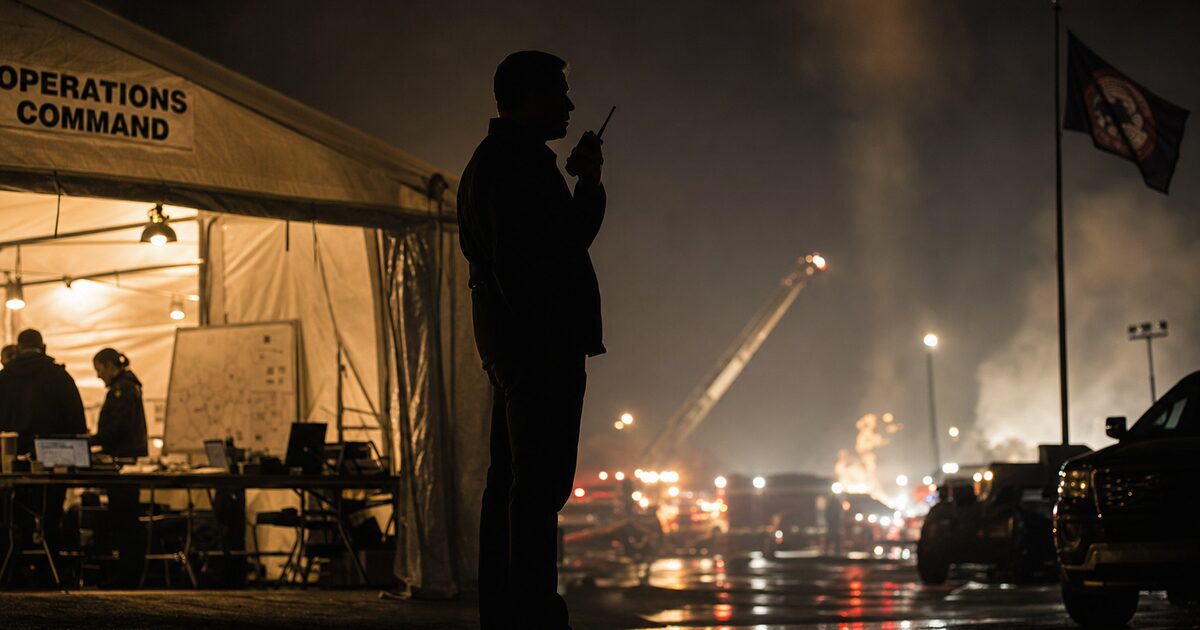
Twenty active years in fire service. First hired in 1993, back to the fire service in 2007, at Roy Fire in 2010, part-time at Weber Fire District since June 2016. Across the recovery arc that followed my 2010 bankruptcy and everything that has come after, I have started and run seventeen American companies, been named a seven-time Inc. 5000 honoree, and been recognized as Utah Business CEO of the Year 2026.
Almost none of what makes those companies work came from a book. It came from the firehouse, and specifically from the way fire service teaches you how to lead under pressure with actual load. What follows is six transfers I use in the boardroom, in the plant in Ogden, and on calls with the team. I will also be honest about the parts that do not transfer, because pretending they do has cost me real money more than once.
Why the firehouse teaches leadership
Fire service teaches leadership the way it teaches everything else. Slowly, by repetition, under stress, with real consequences if you get it wrong. There is no keynote in a firehouse. There are only calls. You either handled the call well or you did not, and everybody on the crew knows which one it was before the rig gets back to quarters.
That feedback loop is the piece most business environments are missing. In a company, most decisions do not have consequences you can see for months. A bad hire takes six months to show up. A wrong strategic bet takes a year. A cultural problem takes two. By the time you know you got it wrong, the decision is so far in the past you cannot tell which choice caused which outcome. On a fire, the feedback is inside twelve minutes. Somebody made a bad call, somebody got hurt, or a building that should have stopped burning kept burning. The lesson is available before the equipment cools off.
The reason firehouse-trained leaders tend to do well in operational businesses is that they have run more decision cycles per year than the average founder. The stakes of any single decision may or may not be higher. What is higher is the count of cycles: decide, execute, review, adjust. That compression is what turns instinct into judgment, and judgment into leadership. The lessons that follow are the ones the compression forced on me.
1. Incident command turns chaos into a checklist
The Incident Command System is the operational framework fire service uses to manage a scene. On paper it is a hierarchy with roles: incident commander, operations, planning, logistics, safety. In practice, it is a way to turn something chaotic into something manageable by assigning one owner to each piece and one person to hold the whole picture.
The reason it works is bounded scope, not the org chart. Once you have named the owner of each piece, everybody else on the scene can stop worrying about the whole picture and focus on their one job. The operations chief runs the attack. The safety officer watches for building collapse. The commander holds the room. Every person knows what to do next because their scope is bounded.
The same thing works in a company crisis. When the plant has a production problem, the temptation is to have everyone in the room trying to solve everything. That is the recipe for a slow, expensive fix. The Incident Command move is to appoint one owner for the production issue, one owner for the customer communication, one owner for the supply chain implication, and one person to hold the whole picture. Everyone else gets out of the room. The problem gets fixed twice as fast because five people stopped trying to make five decisions and started making one.
Founders who have never used Incident Command tend to run every crisis like a group therapy session. Everyone in the room. Everyone with an opinion. Everyone contributing to the "solve." The solve takes twice as long and half as well as it would with clear roles. The fix is boring and it works. Name the owner. Bound the scope. Get everyone else out of the way. Come back together to review after the fire is out.
2. Calm is a decision under load
The most useful thing an officer can bring to a scene is a calm voice. On a fire, calm is a decision the officer makes in the first thirty seconds, before the tones stop echoing in the truck, and the crew reads that decision immediately. What matters about that calm is its steadiness under load. A quiet delivery or a slow cadence can help, but the substance is a settled tone that holds when the room around it does not. That is the practical shape of leading under pressure: you decide once, in advance, that your voice will hold, and then the room borrows the decision from you.
The reason it matters is that the crew reads the officer's tone before they read the officer's words. If your voice is climbing, theirs will climb. If your hands are shaking, theirs will start to shake. Panic is contagious the same way calm is. The officer who has decided to be calm before they arrive gives the crew permission to be calm, and a calm crew makes better decisions on a scene where the wrong decision hurts somebody.
In a business crisis, the calm-is-a-decision move is exactly the same. When a customer is angry, when a plant goes down, when a hire quits at the worst possible moment, the founder's tone in the first five minutes sets the tone for the room. If the founder is anxious, the room is anxious. If the founder is angry, the room is angry. If the founder is calm, and specific about the next step, the room is calm and specific about the next step.
Calm means you have decided, in advance, that whatever is happening will get worked on with a level voice. Calm has nothing to do with feeling unbothered. I have written more about the internal work behind this in why I still work. The discipline of showing up level, whether the day is easy or the day is bad, is the same discipline in the firehouse and at the company. It is a practice you renew every morning, not a personality you are born with.
3. Small crews outperform big ones
A four-person crew on a working fire will outperform a twelve-person crew almost every time, up to a certain scale of incident. The reason is coordination cost. Every person you add to a crew adds communication overhead. Below a certain size, the marginal person adds more capability than they cost. Above that size, they add more cost than they add.
Fire service has spent a hundred years figuring out where that break-point is for different kinds of incidents. Structure fires, medical calls, hazmat, wildland, each has an optimal crew size that has been refined by thousands of after-action reviews. Officers stop adding people at the break-point, not because they are being frugal, but because they know the crew works best there.
Founders almost never do this. Founders add people to a problem when the problem is not moving fast enough, and they keep adding until the problem is moving even slower, and then they add more people to fix the slowness the extra people caused. The Murphy Door plant in Ogden runs the way it runs because we have gotten specific about the crew size for each function, and we do not add people until the workload actually requires it. Adding a person to a well-sized crew is expensive. Adding a person to an under-sized crew is capacity. Knowing which one you have is the officer's job in the firehouse and the founder's job in the plant.
The instinct to add is stronger than the instinct to subtract. Most founders will hire when things are slow before they will trim when things are slow, because hiring feels like action and trimming feels like retreat. The fire service teaches you the opposite instinct through repetition. Every extra person on the fireground is a person you have to protect, coordinate, and account for. If you do not need them, they make the scene harder. If you do need them, they make the scene work. Learn the difference.
4. The person with the radio is not always the person with the answer
On a scene, the incident commander is holding the radio. That does not mean the incident commander has the best information. The engineer on the pump panel might know something about water pressure that the commander does not. The rookie on the nozzle might have seen something inside the building that changes the whole plan. The medic outside with the family might have information the tactical team does not have.
The good commanders know this. They ask. They pause. They pull the crew off to the side when it matters and they listen. The bad commanders talk over the radio and take the input of the person closest to the microphone. The difference between the two is measurable in outcomes. Crews with commanders who ask perform better than crews with commanders who tell.
The company version of this is that the person with the title is not always the person with the answer. The founder is holding the corporate radio. The founder is on the call with the board, the customer, the press, the investors. The founder is often the last person to know what is actually happening at the plant floor, because everything reaches the founder through three filters and a couple of Slack channels.
The fix is boring and it takes discipline. Get out from behind the radio. Go to the plant. Stand in the break room. Ride along on the delivery. Sit in on the customer service calls. Ask the person closest to the work what they see, and then, most importantly, listen to the answer without arguing with it. The founder who trusts the person closest to the work outperforms the founder who trusts the person closest to the microphone. That is true in the firehouse and it is true in every company I have ever run.
5. Training is what shows up when you are tired
Fire service culture is built around training, and specifically around training under fatigue. You do drills after a long shift, in the rain, when you are hungry, when you are angry, when you did not sleep well the night before. The reason is simple. When the tones actually go off, they will go off at the worst possible moment, and the version of you that shows up will be the version that trained under conditions like that. If you only trained rested and comfortable, you will be a rested-and-comfortable firefighter in a situation that is neither.
The company version of this is that your systems and your team are only as good as they are when the founder is tired, the market is bad, and the launch is late. Anything you can only do when the conditions are favorable is a party trick. Real capability shows up when the founder is under-slept, the numbers are ugly, and the room is angry. If your operations only work in a good quarter, they do not work.
The training discipline for a company looks like running your systems on hard mode on purpose. Force the team through fire drills for outages. Rehearse the response to a customer crisis before there is one. Practice the hard conversations. Rehearse the board presentation the way an officer rehearses a first-arriving report. The team that has practiced under pressure will perform under pressure. The team that has only executed on good days will freeze when the day is bad.
I have written about the specific way this shows up in my own week in why I still run into burning buildings. Keeping the shifts at Weber Fire District is part of my training discipline for running the companies. If I stop showing up on hard mode at the firehouse, I lose the calibration I use to run hard days at the company. It is a package.
6. Never leave a firefighter behind translates to how you fire people
The fire service has a rule that reads simply: you never leave a firefighter behind. It applies to a burning building and it applies to a bad call. Nobody goes home alone from a hard scene. Nobody is left to figure out the aftermath by themselves. The tribe holds the person up until they are steady enough to hold themselves up.
The direct company translation is different than what most founders assume. The rule is about how you handle the firing itself, and specifically the moments before, during, and after the meeting where the decision lands. It has nothing to do with protecting bad hires from being fired. If you have to let somebody go, you never leave them without a plan. You do not walk them out with a box and a security guard and a form to sign at the door. You give them a real transition, real information about the reason, real help with the next thing, and, if you can, a call to somebody in your network who might hire them. Some of the hardest firings are cofounder exits, where the operating agreement decides more than the manager does; I have written the mechanics of that in the co-founder equity guide.
I have fired people. Anybody who has run a company for more than five years has. The difference between founders who look back on those firings without shame and founders who cannot bring themselves to think about them is almost always the handling, not the decision. The decision to fire is sometimes the right decision. The way you do it is always your decision. If you do it the way you would want to be treated on the worst day of your career, you will not have regrets. If you do it the way that is cheapest and fastest for the company, you will.
Never leaving a firefighter behind, in the boardroom, is a specific practice. It is longer notice than you legally have to give. It is severance that is more than the market. It is references you actually make instead of "we will not comment." It is a check-in call at ninety days, from you personally, to see how they landed. It costs the company money and hours it does not strictly have to spend. It is also the thing that produces a company where the people who stay know how the people who leave were treated, and they trust the founder because of it. That trust compounds. So does its opposite.
What does not transfer
Some things the fire service teaches do not carry over. The command structure of a working fire is deliberately rigid because rigidity saves lives when the ceiling is coming down. A company that runs the same rigidity will lose every good person who has a better offer inside a year. In business, most decisions are reversible and most days are not on fire. Rigidity in a place that is not on fire looks like fear.
The instinct to run toward the problem is another one. Useful when the problem is a burning building. Dangerous when the problem is a slow-moving strategic mistake. Running at a strategic mistake usually makes it bigger. The right response to most strategic problems is to slow down, gather people, and think out loud. I have made this mistake myself, more than once, and lost quarters to it. The fire service made me good at emergencies. It did not make me good at the parts of a company that are not emergencies, and I have had to learn those the long way.
The last thing that does not transfer well is the assumption that everyone in the room signed up for the same mission. In the firehouse, they did. In a company, they mostly did not. Employees signed up for a paycheck and a job that respects them. Investors signed up for a return. Customers signed up for a product. Aligning those interests is a founder's job. That skill has to be learned somewhere other than the firehouse, because the firehouse does not have that problem to solve in the first place.
The full essay version of this section, with more of the honesty about what I have gotten wrong, is at leadership lessons from the firehouse. This page is the pillar summary. The essay is the personal one.
The shortest version
Run the crisis with named owners. Decide to be calm before you arrive. Keep the crew small enough to work well. Trust the person closest to the work, not the person closest to the microphone. Train on hard mode. When you have to let people go, do it the way you would want to be let go. Do not confuse the firehouse instinct to charge with a strategic instinct that requires patience.
Twenty active years in, both jobs still teach me something new most weeks. Both jobs ask the same thing of me: show up prepared, level, and honest with the crew. The fire service does not need me to be a founder there, and the companies do not need me to be a firefighter there. Everything on this page comes from trying to do that in both places, at the same time, over a long enough stretch that patterns became visible. If any of the six lessons above land, use them. If any of them do not fit your context, drop them. The point is the discipline, not the fire service itself; the discipline of leading under pressure is what carries across.
If you want to hear this conversation happen live, the podcast is 90 Proof Wisdom, and I have founders on it who have done their own version of this from other backgrounds. If you want the book, it is Founder Fallout. And if you want me in the room in person, the speaking page is below.
Book Jeremy to speak
Firehouse leadership, in your room
Keynote and workshop options for conferences, offsites, and leadership development programs. Delivered by a founder who is still on the truck.
Frequently asked questions
Does firefighter leadership training actually transfer to business?
The operational parts transfer directly. Incident command, calm under load, crew sizing, listening to the person closest to the work, and training under fatigue all map onto running a company. The rigid command structure and the run-toward-the-problem instinct do not transfer well and can hurt a company if they are used in the wrong situation.
What is the Incident Command System?
Incident Command is the operational framework fire service uses on a scene. It assigns one clear owner to each function: attack, safety, planning, logistics, and one person to hold the whole picture as commander. The point is that bounded scope lets each person work fast, and the commander holds the coordination. It works the same way in a company crisis.
How do you stay calm as a leader under pressure?
Calm is a decision you make before you arrive, not a personality trait. You decide, in the first thirty seconds, that your voice will be level. The crew reads your tone before they read your words. If you are calm, the room is calm. If you are anxious, the room is anxious. The discipline is renewed every day, not learned once.
What is the optimal team size for a project or crew?
Smaller than founders instinctively pick. Every added person adds coordination cost. Below a certain size the marginal person adds more capability than they cost, above it they add more cost than capability. Fire service has refined these break-points over a hundred years. Founders should figure out the equivalent for each function in their company and stop adding at the break-point.
How can a CEO stay in touch with the frontline of the business?
Get out from behind the radio. Go to the plant. Stand in the break room. Ride along on the delivery. Sit in on the customer service calls. Ask the person closest to the work what they see, and then listen without arguing. The Murphy Door plant in Ogden has a break room I stand in without scheduling it. Half of what I learn about the business comes from that room.
How do you fire an employee the right way?
Never leave the person without a plan. Give real notice, real severance, real information about the reason, and real help with the next thing. Make a call to somebody in your network who might hire them. Check in at ninety days. It costs the company money and hours, and it produces a company where the people who stay trust the founder because of how the people who left were handled.
Why is Jeremy Barker still an active firefighter?
Twenty years in, the shifts at Weber Fire District keep the calibration for running the companies honest. The firehouse teaches decision cycles under real consequences, which is a training environment no boardroom offers. It also keeps me in touch with what an emergency actually is, so I do not treat annoying business problems like emergencies.